

TECNIS Odyssey IOL: The New Face of Cataract and Presbyopia Surgery

Has your doctor mentioned the "Odyssey lens" while talking about your cataract surgery? You probably have questions. What does "full visual range" even mean? Is it safe? Will you actually be able to stop wearing reading glasses?
What Is an IOL, and Why Does the Type Matter?
During cataract surgery, your eye's own lens (the part that's turned cloudy) is taken out and replaced with a small artificial lens called an IOL. This new lens stays in your eye for life. Its job is simple: focus light so you can see clearly.
But not all IOLs work the same way. A basic lens gives you clear vision at just one distance, usually far away, so you'll still need reading glasses. A premium lens like the Odyssey is built to give you clear vision up close, in the middle distance, and far away — all with one lens, ideally without needing glasses at all.
What Makes the Odyssey Lens Different
The Odyssey is built on a lens platform that has been tested and refined for over 20 years, so the base of the lens isn't new or unproven. What's new is the surface design.
Older multifocal lenses work a bit like a lens split into a few separate "zones" — one for near, one for far, sometimes one for the middle. Your brain has to pick which zone to use at any moment. This usually works fine, but it can cause rings of light or glare around headlights at night, because some light is always going to a zone you're not using right then.
The Odyssey IOLs takes a different approach. Engineers used advanced computer design to smooth out the jumps between near, middle, and far focus into one continuous, blended range. In simple terms, your vision flows more naturally between distances instead of switching abruptly — closer to how your eyes worked before you needed reading glasses.
How the "Diffraction" Part Works
This is the part that confuses most people, so let's slow down.
Regular glasses work through refraction — light bends through curved glass and lands in one place. Simple, but it only gives you one point of clear focus.
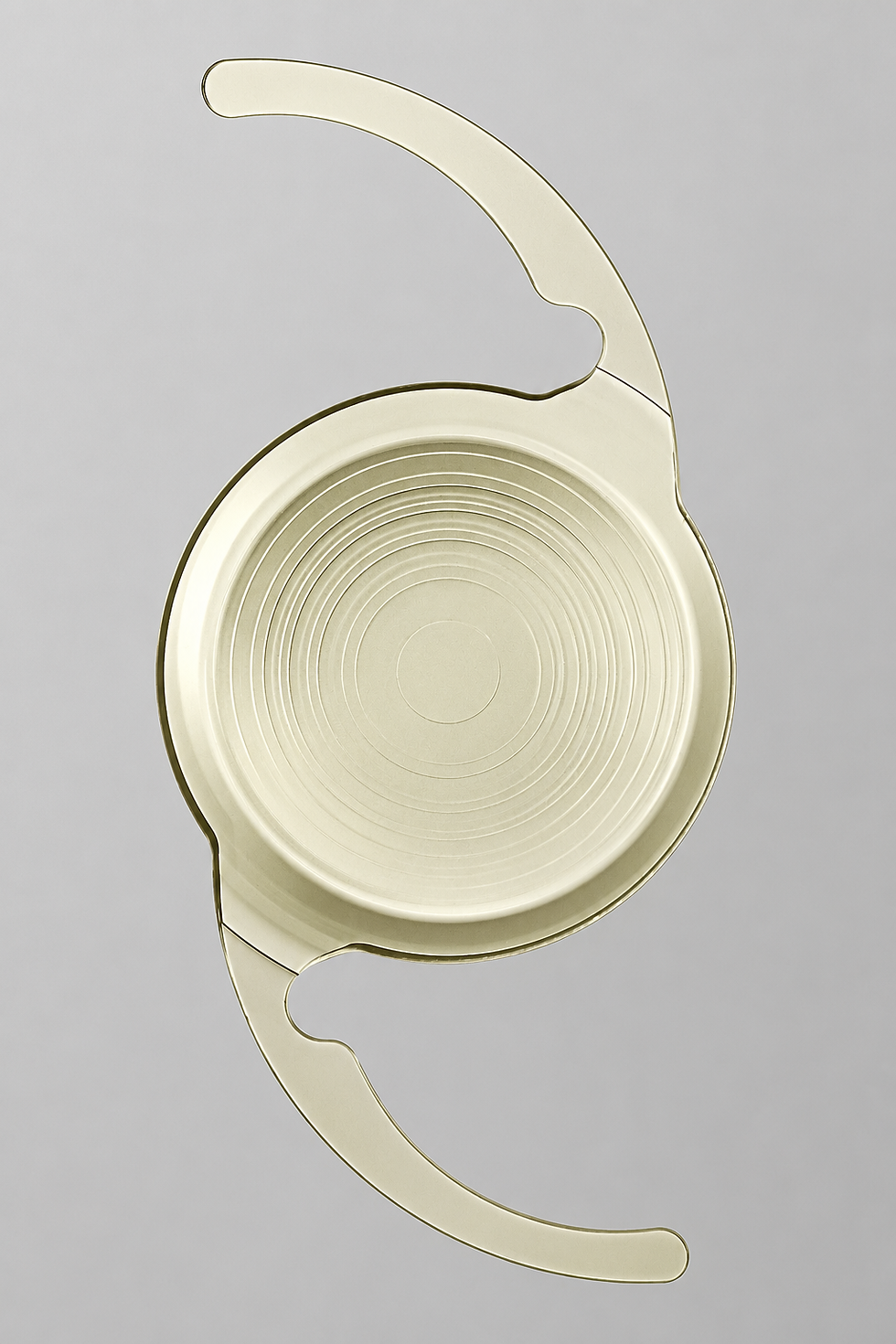
Diffractive lenses work differently. The back of the lens has tiny, ring-shaped steps carved into it, too small to see with the naked eye. As light passes through, it's deliberately split so it can focus at more than one distance at once. Your brain then does the clever part — it leans on whichever image is sharpest for whatever you're looking at and quietly tunes out the rest. This adjustment is called neuroadaptation, and for most people it happens gradually over the first few weeks after surgery.
What makes the Odyssey different is that its rings are much finer than the manufacturer's older multifocal lens — the individual steps are over 50% smaller. Finer steps mean more precise control of light, which is a big reason this lens is designed to cause less glare and fewer halos than older designs.
Why This Lens Is Getting So Much Attention
It's forgiving of small imperfections: No surgery is mathematically perfect every time — eyes heal a little differently from person to person. In lab testing, most eyes with the Odyssey still saw sharply even when there was a small amount of leftover short-sightedness, long-sightedness, or astigmatism after surgery. In plain terms: less worry about needing a touch-up procedure later.
Less glare and fewer halos at night: In a real-world check-up one month after surgery, the vast majority of patients reported no visual disturbances at all, or only mild ones — a noticeably better result than older-generation trifocal lenses tend to show.
Genuinely smooth, continuous vision: In lab comparisons against a leading trifocal lens, the Odyssey performed better at the closer end of the reading range and had a wider "sweet spot" across the whole zone from far to near, meaning fewer awkward in-between distances where things blur.
Strong contrast, even in low light: Contrast is how well you can make out shapes and edges when it's dim, like at dusk or in a dark hallway. The Odyssey was built to hold onto contrast better than both a competing standard lens and a competing trifocal lens under those dimmer conditions.
Happy patients in the real world: In after-surgery surveys, most patients said they were satisfied with their vision without glasses, their ability to read on a phone or tablet, and their ability to see steps and curbs safely at night. Most also said they weren't wearing glasses at all anymore.
An astigmatism-correcting version exists: If you have noticeable corneal astigmatism, there's a toric version of this lens that fixes both the astigmatism and the presbyopia together, with a design built to help it stay firmly in place after surgery.
How the Odyssey Compares to PanOptix and PureSee or Other Trifocal IOLs
Two other lenses come up constantly in these conversations, so here's a simple side-by-side.
PanOptix has been one of the most popular lenses of its kind for years. It gives strong near, middle, and far vision using the classic "split light into separate zones" approach. It's a proven, well-studied lens — but because it relies more heavily on splitting light into distinct zones, it tends to come with a higher chance of glare and halos at night compared to newer designs.
PureSee takes a completely different route. Instead of splitting light with diffractive rings at all, it uses a smoothly curved surface to gently stretch your focus range. This means very few patients report glare or halos, similar to a standard lens. The trade-off is that PureSee doesn't aim for strong up-close reading vision the way a true multifocal lens does — it's built more for people who want clearer middle-distance vision (like a computer screen) with the lowest possible risk of night-vision side effects, and who are less bothered by still needing reading glasses sometimes.
Odyssey is trying to sit in the middle of these two, without the usual trade-off. It's designed to give near vision that's as strong as PanOptix, while keeping the low glare and halo rates closer to what you'd expect from a gentler lens like PureSee. Whether it actually delivers "the best of both" for your particular eyes is something only your surgeon can confirm after a full exam.
In one line: PanOptix leans hardest into close-up reading vision, PureSee leans hardest into comfort and low night-glare, and the Odyssey is aiming to give you both at once.
Being Honest About the Trade-Offs
No premium lens is magic, and any good clinic will tell you that upfront. A few honest points:
Some glare or halos are still possible, especially in the first few weeks. For most people, this fades noticeably as the eye and brain adjust.
Adjusting takes time. It's completely normal to need a few weeks, sometimes longer, before your vision feels fully natural.
Precision matters. The best results depend on accurate measurements before surgery, a healthy eye surface, and a surgeon experienced with this type of lens.
Who This Lens Isn't Right For
Multifocal, full-range lenses like the Odyssey aren't for everyone. A good surgeon will screen carefully first. People who generally shouldn't get this type of lens include those with:
Significant corneal scarring or an irregularly shaped cornea (like untreated keratoconus)
A history of corneal surgery, in many cases
Glaucoma or retinal disease that already limits vision quality
Unusual alignment between the eye's visual axis and its shape, found during a pre-surgery exam
Any condition flagged during a full eye exam as likely to reduce how well a multifocal lens would work
If any of this sounds like you, it doesn't mean you're stuck with glasses forever. It usually just means your surgeon will guide you toward a different lens, like a standard monofocal or a gentler option like PureSee, that's safer and more predictable for your eyes.

The Bottom Line
The TECNIS Odyssey is a real step forward in premium cataract lens design. It's built to give a fuller, smoother range of clear vision, with fewer of the night-vision trade-offs that older multifocal lenses are known for. It won't be the right fit for everyone, and no article can replace an honest, one-on-one conversation with your surgeon about your eyes and your daily life.
At Claritas Eye and Retina, Dr. Mayank Bansal and the team walk every patient through a detailed evaluation before recommending any lens — matching your eye health, your lifestyle, and your expectations to the option that's genuinely right for you, not just the newest one on the market.


Comments